Boards
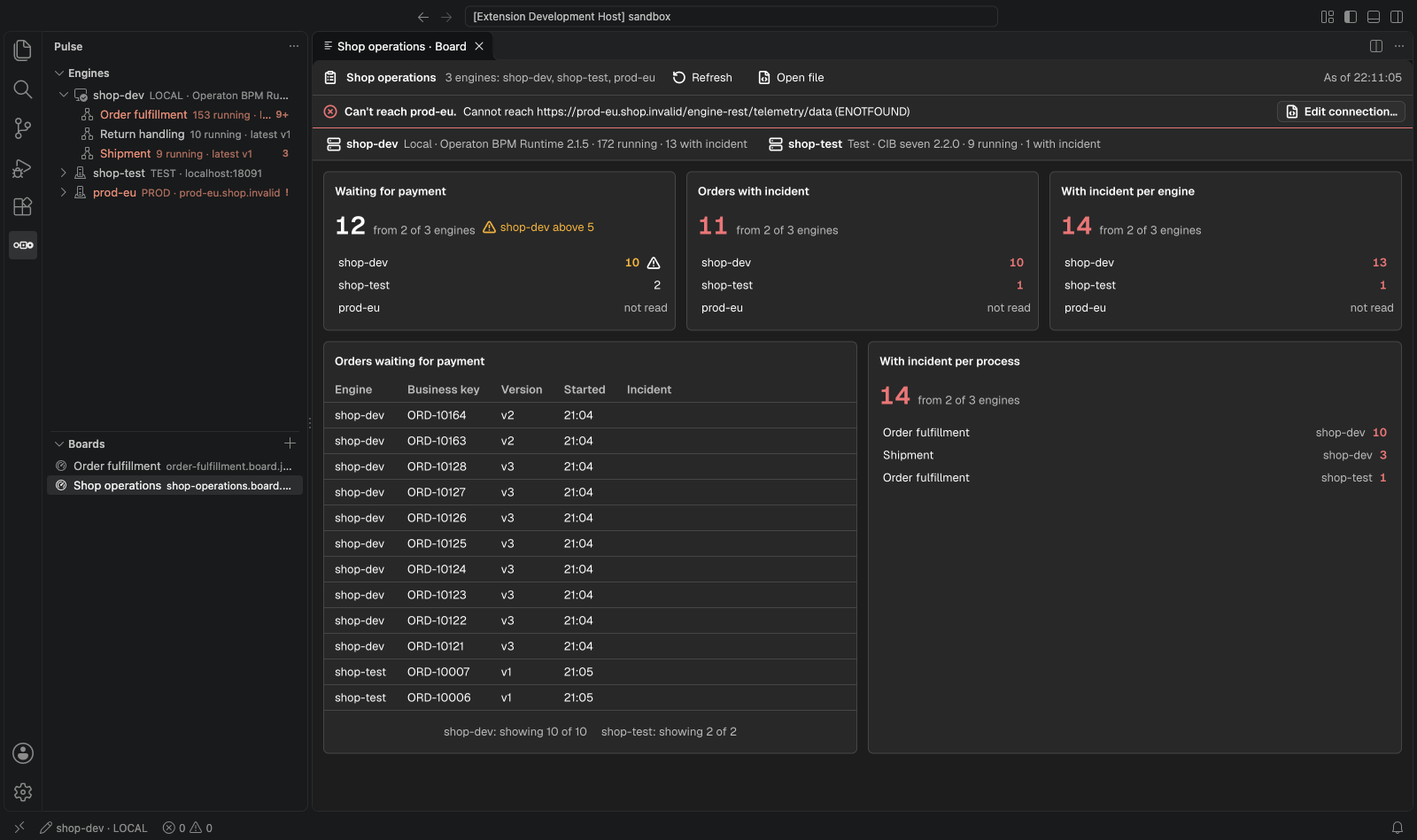
A board keeps the operational questions your team asks again and again in one view: how many orders wait for payment, which processes have incidents, which instances run at a step. A board is a JSON file in your repository, so it is versioned and shared like the code. It only reads; it never writes to an engine.
A board file
Pulse reads every .pulse/boards/*.board.json in the workspace and lists it in the Boards view. Pulse: New Board… writes a starter board with your engines. Editing the file gives completion and checks from the board schema; Pulse reloads an open board when you save.
{
  "schemaVersion": 1,
  "title": "Shop operations",
  "engines": ["shop-dev", "shop-test"],
  "rows": [
    {
      "row": [
        {
          "widget": "counter",
          "props": {
            "title": "Waiting for payment",
            "filter": { "process": "order-fulfillment", "activeElement": "Activity_AwaitPayment" },
            "warnAbove": 5
          }
        },
        { "widget": "incidentSummary", "props": { "groupBy": "process" } }
      ]
    },
    {
      "row": [
        { "widget": "instanceList", "props": { "filter": { "process": "order-fulfillment" } } }
      ]
    }
  ]
}
engines names profiles of .pulse-cli.json. A widget may narrow them with its own engines.
| Widget | Shows |
|---|---|
counter | How many instances match, per engine and in total; warnAbove warns per engine |
instanceList | The first 50 matching instances of each engine with the total of each, in one table |
incidentSummary | Instances with an open incident, groupBy engine or process |
processDiagram | The deployed diagram of one engine (process, latest version) with its counts per element |
incidentList | The first 50 open incidents of each engine with element and message, optionally of one process |
The filter takes process (BPMN process ID, every version), activeElement (needs process), state (running, the default, or ended), withIncident and businessKey. Columns are engine, process, version, businessKey, state, startedAt, endedAt and incident.
Several engines
Every row and every number keeps the engine it came from, and a click opens the instance or the process on that engine. An engine that cannot be read, or that is not in your .pulse-cli.json, gets one strip on top and "not read" in its cells; a total then says how many engines it counts. A click on a count in a diagram opens the process filtered to that element. A broken file lists each problem with its path and reason and keeps showing the last valid version.